When planning commercial construction in North Georgia, your foundation system choice impacts budget, timeline, and building performance for decades. The decision between monolithic slab and stem wall foundation types depends on how each concrete foundation system handles Metro Atlanta’s expansive red clay soil, manages drainage on sloped terrain, and aligns with your project requirements.
This foundation cost comparison guide provides local context: performance in Cherokee County’s red clay, actual market dynamics, and which foundation solution suits your commercial property.
Foundation System Performance in Metro Atlanta’s Red Clay Soil
How North Georgia’s Expansive Clay Affects Foundation Types
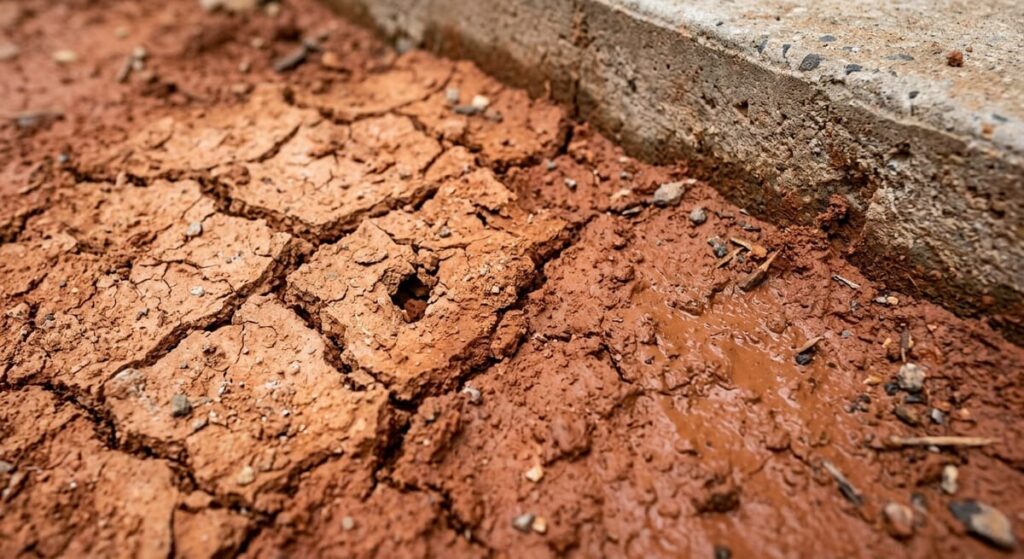
Metro Atlanta sits on challenging soil conditions. Our red clay expands when wet and contracts during dry periods, creating continuous pressure on concrete foundations in direct contact with soil.
Expansive clay creates two primary challenges. First, soil can expand up to 10% in volume during heavy rainfall, pushing upward against slabs. Second, during Georgia’s dry spells, clay contracts and pulls away from foundation walls, creating voids that allow settlement.
The clay’s plasticity index ranges from 15 to 35 in Metro Atlanta. Sandy soils have indices below 10. This fundamental difference means foundation designs that work in coastal Georgia fail in our region.
Building codes in Cherokee, Cobb, and Fulton counties require soil classification reports for commercial projects because local conditions vary significantly even within the same development.
Monolithic Slab Foundations on Red Clay
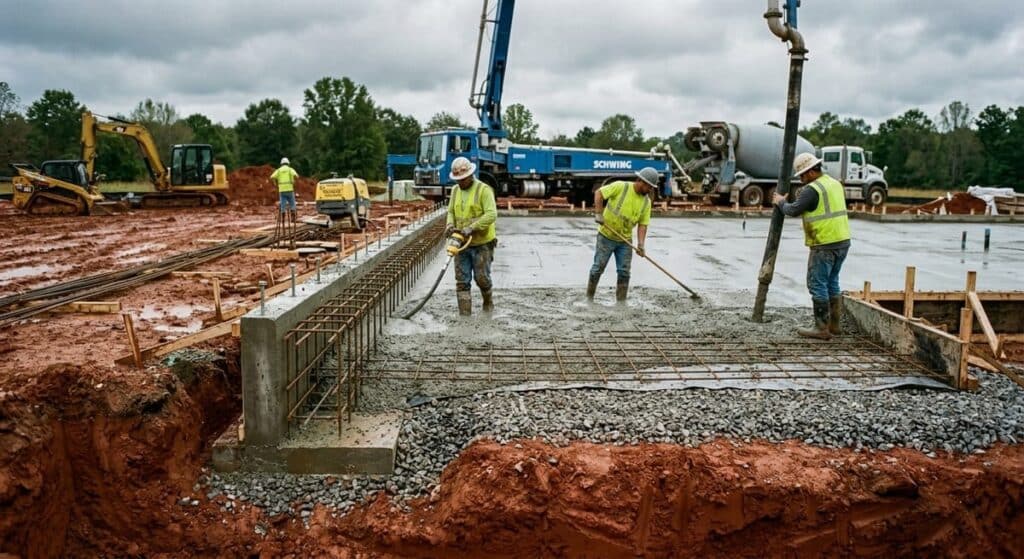
Monolithic slab foundations sit directly on prepared red clay as slab on grade systems. Proper installation with adequate site preparation ensures reliable performance.
The key to monolithic slab success is moisture control. Site grading directs water away from the foundation perimeter, while vapor barriers prevent ground moisture from wicking upward. Crushed stone base layers (4-6 inches of compacted material) create capillary breaks that reduce moisture contact with concrete.
Monolithic pour foundations benefit from flexibility—they move slightly with minor soil shifts without cracking. Thickened edges around the perimeter provide structural support while the center section remains thinner. For commercial buildings on relatively flat lots with good drainage, properly prepared monolithic slabs handle red clay conditions effectively.
Vulnerability comes with inadequate preparation. If grading allows water pooling or if the subbase isn’t properly compacted, red clay beneath creates uneven support conditions leading to settlement and cracking. Professional geotechnical engineers recommend minimum bearing capacity of 1,500 pounds per square foot for monolithic slab systems on prepared clay soils.
Stem Wall Foundation Systems on Red Clay
Stem wall foundations elevate commercial buildings above grade, creating crawl space between ground and floor system. This raised foundation approach provides critical advantage on expansive clay: minimizing direct soil contact with building structure.
Stem wall construction distributes building loads differently than monolithic slabs. Concrete footings sit below the frost line foundation depth (12 inches deep in North Georgia) and bear on compacted soil. Spread footings transfer loads across wider surface areas, reducing pressure on expansive clay beneath. Vertical stem walls rise from footings to support the building frame above. The floor system spans between walls, creating an air gap that isolates your building from ground moisture and soil movement.
In Canton, Holly Springs, and Ball Ground (where sloped commercial lots are common), stem wall systems excel at managing elevation changes. Rather than extensive cut-and-fill grading to create level building pads, stem walls accommodate terrain while maintaining level floor elevations. This adaptability reduces total earthwork expenses on properties with grades exceeding 8-10%.
The crawl space provides practical advantages beyond soil isolation. Plumbing, electrical, and HVAC systems run through accessible space, making future maintenance simpler than slab-on-grade construction alternatives. Crawl space height ranges from 18 to 36 inches, providing sufficient clearance for inspections and utility work.
Drainage and Slope Factors for Foundation Selection
Commercial properties across Cherokee, Cobb, and Fulton counties face varying drainage challenges based on terrain.
Slope percentage determines which foundation system offers natural drainage advantages:
| Slope Percentage | Best Foundation Type | Considerations |
| Less than 5% | Either type viable | Proper site grading required for both |
| 5-10% | Either type viable | Stem walls reduce grading work |
| Above 10% | Stem walls preferred | Working with terrain vs. against it |
Metro Atlanta’s rainfall patterns (averaging 52 inches annually with intense summer thunderstorms) make drainage non-negotiable. Water must move away from foundation perimeter quickly. Monolithic slabs require careful grading to direct runoff, while raised foundation systems benefit from natural elevation preventing water pooling.
French drains, perimeter swales, and proper site grading are essential regardless of foundation type selected.
Complete Foundation Type Comparison
What Is a Monolithic Slab Foundation System?
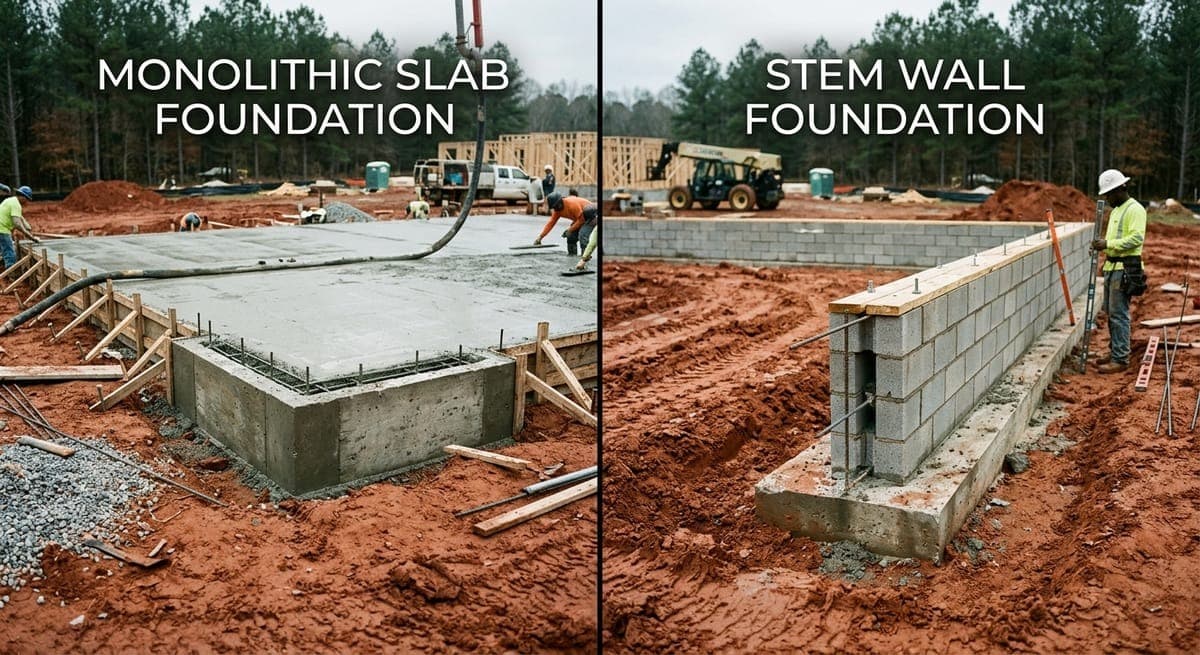
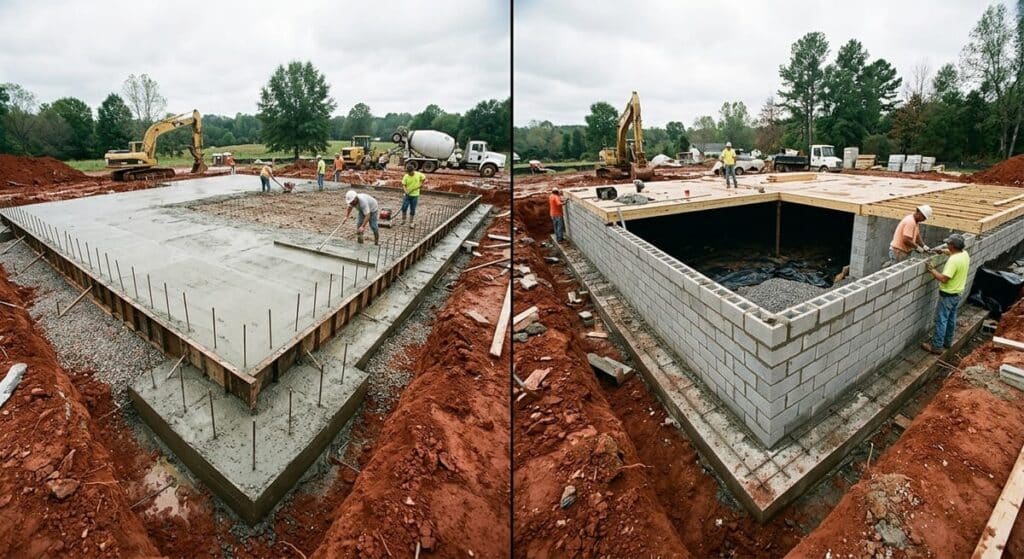
A monolithic slab foundation combines floor slab and perimeter footing into a single concrete placement. “Monolithic” means “formed from a single piece”—the entire foundation pours in one continuous operation using the monolithic pour method.
Construction begins with site preparation. The building footprint is excavated to remove topsoil and organic material (6-12 inches deep). Workers create trenches around the perimeter where the slab will be thicker to carry structural loads. These perimeter beams measure 12-16 inches deep and 12-18 inches wide. Crushed stone fills the excavation to create stable, draining base layer. Vapor barrier covers the stone to prevent moisture migration.
Rebar or welded wire mesh reinforces the concrete throughout. Plumbing lines run beneath the slab before the pour—once concrete hardens, these systems become permanent.
The concrete pour happens in a single day. Crews place concrete in perimeter trenches and across the slab area simultaneously, creating one monolithic unit without cold joints.
What Is a Stem Wall Foundation System?
Stem wall construction separates footing, wall, and floor into distinct components that work together as a structural system. This multi-stage foundation solution creates elevated crawl space beneath commercial buildings.
Construction starts below grade with concrete footings at frost line foundation depth. Spread footings bear on undisturbed or properly compacted soil below frost line. Standard footing dimensions range from 16-24 inches wide and 8-12 inches thick, depending on structural loads and soil bearing capacity.
After footings cure, vertical concrete walls rise from footings around the building perimeter and beneath interior load-bearing walls. These stem walls stand 18-36 inches tall, creating crawl space.
Floor framing spans between stem walls. Commercial concrete construction uses 2×10 or 2×12 floor joists spaced 16 inches on center. The resulting air gap between ground and floor isolates your building from ground moisture and allows utility installation.
Key Structural Differences Between Foundation Systems
The fundamental difference lies in how each foundation type transfers building loads to soil and interacts with ground beneath your structure.
Monolithic slabs create rigid mats that spread loads across entire building footprints. The slab moves as a single unit—if soil settles unevenly beneath one section, the entire slab responds. Continuous reinforcement and monolithic pour eliminate joint vulnerabilities but provide limited ability to accommodate differential settlement.
Stem wall systems create perimeter load paths. Building weight concentrates on footings beneath stem walls rather than distributing across full floor area. The elevated floor system remains independent from soil movement, protected by the air gap in crawl space.
Construction timelines differ significantly. Monolithic slab foundations complete in 5-7 days from excavation through final cure. Stem wall construction requires 10-14 days due to multiple concrete placements.
Monolithic Slab Foundation Advantages and Limitations
Monolithic Slab Pros:
- Faster construction (7-10 days pour-to-occupancy)
- Lower initial investment
- Simplified utility installation during construction
- Minimal maintenance requirements
- Thermal mass benefits moderate temperature swings
Monolithic Slab Cons:
- Limited future flexibility for utilities
- Ground moisture exposure requires perfect vapor barrier
- Slope limitations require extensive grading
- Settling concerns on clay soil
- Plumbing modifications require concrete cutting
When monolithic slab foundations excel: Projects with tight completion deadlines, simple utility layouts that won’t require future modifications, relatively flat lots with good drainage, and budget-conscious projects on stable soil.
Stem Wall Foundation Advantages and Limitations
Stem Wall Pros:
- Superior drainage management on sloped lots
- Utility access and flexibility for modifications
- Slope adaptation without excessive grading
- Soil movement isolation protects structure
- Enhanced structural inspection capability
- Better pest management through crawl space control
Stem Wall Cons:
- Higher initial investment
- Extended construction timeline (10-14 days)
- Crawl space maintenance requirements
- Added construction complexity
- Floor system requires insulation
When stem wall foundations excel: Sloped lots in Canton and Ball Ground, buildings with complex mechanical systems, multi-tenant commercial properties, and sites with poor drainage or foundation for clay soil conditions.
Foundation Cost Considerations in Metro Atlanta
Understanding Foundation Investment
Foundation system selection involves balancing upfront construction expenses against long-term building performance and maintenance considerations.
Monolithic slab foundation systems represent lower initial investment due to simplified construction process and reduced material requirements. Single-pour installation reduces labor hours and equipment time on site.
Stem wall foundation systems involve higher initial investment due to multi-stage construction. Separate footings, walls, and floor framing require additional materials, labor, and time.
Cost Variables for Foundation Systems
Several site-specific factors influence foundation expenses in this foundation cost comparison:
Slope and grading requirements create the largest expense variable. Flat lots with minimal grading needs stay toward lower ranges. Properties requiring significant cut-and-fill work, retaining walls, or extensive drainage installations increase expenses regardless of foundation type selected.
Soil conditions and preparation needs vary across Metro Atlanta. Lots with stable, well-draining soil over bedrock require minimal excavation and base preparation. Properties with deep clay deposits, high water tables, or organic soil that must be removed add significant expenses.
Building loads and structural requirements determine concrete thickness, reinforcement density, and footing sizes. Heavier commercial structures with masonry walls or multiple stories require more substantial foundation systems.
How to Choose the Best Foundation for Your Metro Atlanta Project
Lot Assessment for Foundation Selection
Your property’s physical characteristics determine which foundation solution offers best performance and value.
Evaluate slope first. Measure grade change across your building footprint. Lots with less than 3% slope work equally well with either foundation type. Between 3-8% slope, both remain viable, but calculate grading expenses for monolithic slabs against stem wall considerations. Above 8% slope, stem wall systems require less extensive grading work.
Assess drainage patterns. Walk your property during and after heavy rain. Properties with poor natural drainage need engineered solutions regardless of foundation type, but raised foundation systems provide built-in elevation that monolithic slabs must achieve through site grading.
Check soil conditions. Review available geotechnical reports from nearby properties or request soil borings for your site. Soil reports reveal clay depth, bearing capacity, water table levels, and special preparation requirements affecting both foundation performance and investment.
Project Type and Long-Term Goals
The intended use of your commercial building and future plans influence which foundation system serves you best.
New construction projects offer full flexibility to choose the foundation type matching your terrain, budget, and building design. Consider mechanical system design—buildings with significant HVAC, plumbing, or electrical requirements benefit from stem wall crawl space access.
Multi-tenant commercial properties face higher likelihood of future modifications as tenants change. Stem wall foundation systems accommodate plumbing relocations, electrical upgrades, and HVAC system modifications more economically than slabs requiring concrete cutting for each change.
Budget and Value Alignment
Initial budget constraints may drive foundation choice on straightforward projects. When your lot has minimal slope, good drainage, and stable soil, properly installed monolithic slab foundations deliver reliable performance at lowest first investment.
Long-term value considerations justify stem wall advantages. The combination of better moisture control, utility access, and soil movement isolation reduces maintenance expenses and simplifies building modifications over decades of service. For commercial properties in sloped terrain like Canton or Ball Ground, stem walls require less grading expense than monolithic slabs.
Making Your Foundation Selection Decision
Start by gathering site information: property survey showing grade elevations, soil conditions from geotechnical investigation, and drainage patterns observed during site visits.
Schedule consultations with experienced commercial concrete foundation contractors who work regularly in Metro Atlanta. Quality contractors provide site-specific recommendations based on your property conditions.
Request detailed estimates that break down expenses by component: site preparation, materials, labor, and special requirements your property demands.
Review local building code requirements with your contractor. Cherokee County, Cobb County, and Fulton County enforce slightly different interpretations of International Building Code, affecting foundation design details and inspection procedures.
The best foundation for your Metro Atlanta commercial project matches your site conditions, supports your building design, fits your budget, and performs reliably on our region’s red clay soil for decades to come./
Frequently Asked Questions
Which Foundation Type Works Better in Metro Atlanta’s Red Clay Soil?
Both foundation types work reliably in red clay when properly installed with appropriate drainage systems. Stem wall foundations minimize direct soil contact through elevation, while monolithic slabs require excellent moisture barriers and site preparation. Success depends more on proper installation than foundation type selection.
Which Foundation Can Be Built Faster in North Georgia?
Monolithic slab foundations install faster, completing in 5-7 days from site preparation through final cure. Stem wall construction takes 10-14 days due to multi-stage work requiring footings, walls, and floor framing as separate components with necessary curing time between stages.
How Do These Foundations Handle Drainage on Sloped Metro Atlanta Lots?
Stem wall foundation systems handle drainage better on sloped terrain because they elevate buildings above grade level, preventing water pooling against structures. Monolithic slab foundations require excellent site grading and perimeter drainage systems since they sit at ground level.
How Long Do These Foundations Last in Georgia’s Climate?
Both concrete foundation systems last 50+ years in Georgia’s climate when properly installed with correct drainage systems and site preparation. Longevity depends more on quality installation, effective drainage management, and proper soil preparation than foundation type selection.