When you’re planning concrete flooring for warehouses, manufacturing facilities, or equipment storage buildings, residential concrete standards don’t apply. Your concrete slab must handle concentrated point loads from forklift tires, repeated traffic patterns, and the specific equipment you operate daily.
The minimum concrete slab thickness for heavy equipment starts at 6 inches for light industrial use. Real-world applications need 8 to 12 inches depending on your forklift capacity, traffic frequency, and soil conditions. Underspecifying thickness creates cracking under point loads, surface spalling from forklift tires, joint deterioration, and complete structural failure requiring replacement at 10 to 15 times the cost of proper initial construction.
This guide addresses thickness requirements for facilities across North Georgia, where expansive clay soil and seasonal moisture fluctuations create challenges beyond basic load calculations.
Industrial Concrete Slab Thickness Requirements by Application
| Application Type | Minimum Slab Thickness | Typical Equipment | Reinforcement Requirements |
| Light Industrial & Assembly | 6 inches | Standard forklifts (<8,000 lbs capacity), assembly equipment | #4 rebar at 18″ spacing or 6×6 W2.9 wire mesh |
| Warehouse & Distribution | 8 inches | Sit-down forklifts (up to 15,000 lbs), pallet racking | #5 rebar at 12″ spacing, joints every 15 feet max |
| Heavy Manufacturing | 10-12 inches | Reach stackers, overhead cranes, stamping presses (>20,000 lbs/axle) | Engineered reinforcement, potential post-tensioning |
| Semi-Truck Traffic | 12+ inches | Tractor-trailers, container handlers, heavy-haul equipment | Structural engineering required, custom mix design |
When Standard Minimum Thickness Requirements Don’t Apply
Choose thicker slabs than building code minimums when:
- Equipment manufacturers specify floor loads exceeding standard classifications
- Rack systems create concentrated loads at post locations
- Future equipment upgrades or heavier machinery are planned
- Soil testing reveals bearing capacity concerns
North Georgia’s expansive clay soil frequently pushes actual requirements 1 to 2 inches above theoretical minimums due to upward pressure from soil movement that static load calculations don’t account for.
How to Determine Correct Concrete Thickness for Your Equipment
Four factors control industrial floor slab thickness design: equipment load characteristics, traffic patterns, soil bearing capacity, and joint layout requirements.
Equipment Load Analysis and Thickness Calculation
Point loads versus distributed loads require fundamentally different approaches. A 10,000-lb forklift creates different floor stress than a 10,000-lb static machine. The forklift concentrates weight onto four small tire contact patches, just 4 to 6 square inches each under front wheels when carrying full load.
Calculate actual ground pressure by dividing total equipment weight by contact area. A standard 5,000-lb capacity sit-down forklift places roughly 70% of total loaded weight on the front axle, approximately 8,000 to 9,000 lbs distributed across two tires with 12 square inches total contact area. This creates 750 PSI ground pressure at tire contact points.
The concrete itself (3,000 PSI allowable bearing stress for 4,000 PSI mix) can handle the pressure, but proper thickness distributes loads to the subgrade below while managing repeated loading cycles and dynamic forces from stopping and turning.
Traffic Intensity and Pattern Effects on Slab Thickness
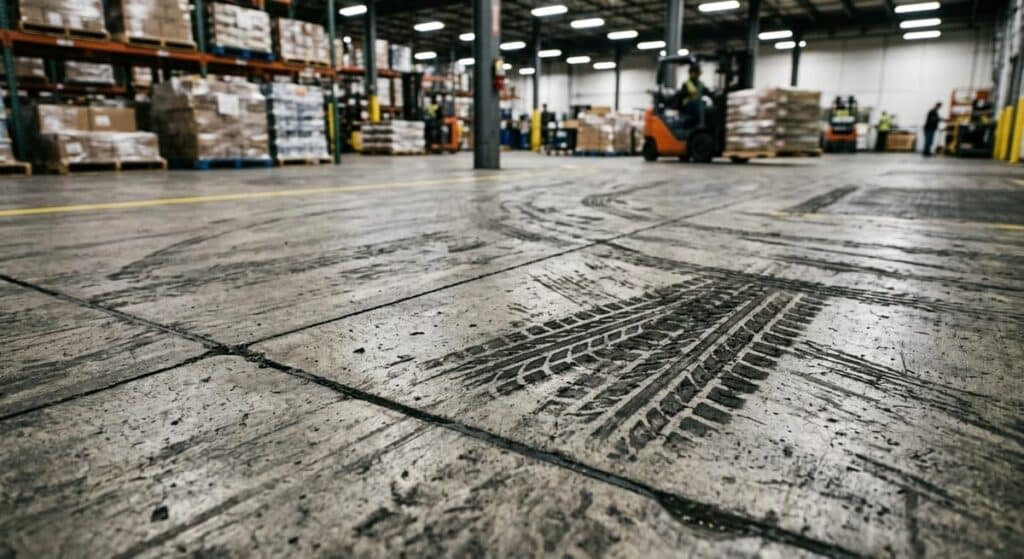
A warehouse with two forklifts making 50 trips daily creates different pavement stress than a distribution center running 10 forklifts on continuous cycles. Repetitive loading at identical locations, particularly at rack aisles, doorways, and transition zones, causes fatigue damage that static calculations don’t capture.
Joint crossing represents the highest-stress event in forklift operations. Every loaded forklift crossing a joint creates impact loading exceeding static weight by 30% to 60%. High-traffic aisles can experience 200 to 500+ crossings per day at specific joints, creating cumulative stress that factors into thickness calculation.
Georgia Clay Soil Considerations for Concrete Slab Design
Expansive clay soil across Cherokee, Cobb, and Fulton Counties creates subgrade conditions standard thickness tables don’t address. The red clay common throughout north Georgia shrinks during dry summer months and swells with fall and spring moisture, creating cyclical heaving pressure beneath slabs.
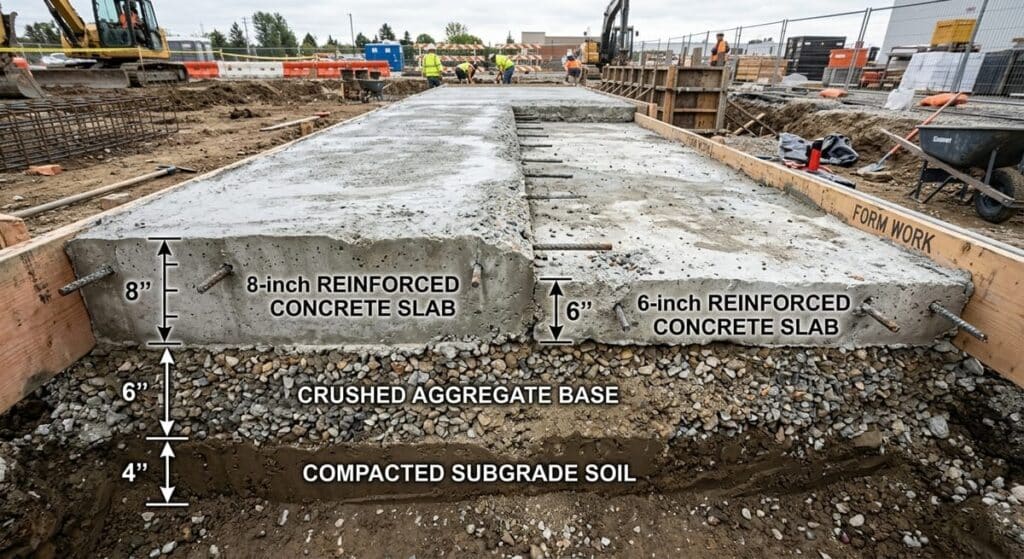
Proper base preparation for heavy equipment slabs in Georgia requires 8 to 12 inches of compacted Class II aggregate base, compared to 4 to 6 inches sufficient on stable soil. The thicker base layer increases floor system stiffness to resist soil movement and creates a capillary break reducing moisture transmission from clay into concrete.
Standard clay soil in this region provides 2,000 to 3,000 PSF bearing capacity. Compacted structural fill can improve bearing to 4,000+ PSF. Actual bearing capacity directly affects required thickness because the slab must bridge areas of differential settlement.
Rebar Requirements for Concrete Slab Reinforcement
Thickness and reinforcement work together. An 8-inch slab with inadequate reinforcement performs worse than a properly reinforced 6-inch slab under many loading conditions.
Standard industrial reinforcement uses #4 or #5 rebar (1/2-inch to 5/8-inch diameter) placed at mid-depth in both directions. Spacing varies from 12 inches on center for heavy-duty applications to 18 inches for lighter industrial use. The reinforcement doesn’t prevent cracking but controls crack width and maintains load transfer across cracks.
Post-tensioned slabs use high-strength steel cables stressed after concrete curing to create compression throughout the slab. This method allows larger joint-free areas and reduces thickness requirements by 1 to 2 inches compared to conventionally reinforced slabs.
ACI Concrete Slab Thickness Standards and Design Requirements
Industrial floor slab design follows engineering principles documented in ACI 360 (American Concrete Institute guide for concrete floor systems) and local building codes adapted to Georgia conditions.
Load Distribution Mechanics and Thickness Design
Thick slabs act as rigid pavements, distributing concentrated loads across wider subgrade areas. An 8-inch slab spreads a point load across approximately 3 to 4 feet of subgrade width. A 6-inch slab distributes force across roughly 2.5 to 3 feet. This difference determines whether the subgrade experiences stress within bearing capacity or exceeds it and settles.
ACI 360 provides design tables based on subgrade modulus (k-value in pounds per cubic inch), concrete flexural strength (modulus of rupture), and anticipated wheel loads. Georgia clay soil tests at k-values of 100 to 200 PCI undisturbed, increasing to 200 to 300 PCI with proper aggregate base preparation.
Joint Layout Requirements and Slab Thickness
Control joint spacing decreases as thickness increases. Thicker slabs develop higher tensile stresses from concrete shrinkage and temperature change, requiring closer joint spacing to control random cracking. An 8-inch industrial slab needs joints at 12 to 15-foot spacing, while a 6-inch slab might extend to 18-foot spacing.
Forklift traffic demands positive load transfer at every joint through dowel bars or aggregate interlock. Without load transfer, joint edges experience progressive faulting where one side settles relative to the other, creating a vertical lip that forklift wheels impact on every crossing.
Dowel bars for industrial slabs use 3/4-inch or 1-inch diameter smooth steel bars, 18 inches long, spaced at 12 inches on center. The bars must be positioned at mid-depth and aligned parallel to traffic direction to function properly.
Concrete Mix Design for Heavy Duty Performance
Higher compressive strength provides better abrasion resistance, reduces shrinkage cracking, and improves long-term durability under repetitive loading. Industrial applications require 4,000 PSI minimum compressive strength, with heavy-duty operations specifying 4,500 to 5,000 PSI.
Well-graded aggregate distributions reduce water demand and improve workability during placement. Maximum water-cement ratio of 0.45 for industrial floors (compared to 0.50+ for residential) produces denser concrete with superior performance characteristics.
Floor Flatness Specifications for Heavy Equipment Operations
Heavy equipment operations require specific floor flatness tolerances. The FF/FL system measures floor quality. Floor Flatness (FF) quantifies surface waviness over short distances, while Floor Levelness (FL) measures deviation from level over the entire floor area.
Standard warehouse with reach trucks requires FF25/FL20 minimum. Narrow-aisle equipment demands FF35/FL25 minimum. High-bay automated or VNA systems need FF45/FL30 minimum, sometimes tighter.
Achieving tight flatness specifications requires laser-guided screeding equipment, skilled finishing crews, and adequate thickness to resist deflection during finishing operations. Eight-inch minimum thickness provides the rigidity necessary for high-quality finishing.
Best Construction Methods for Industrial Concrete Slabs
Subgrade Preparation Requirements for Proper Thickness
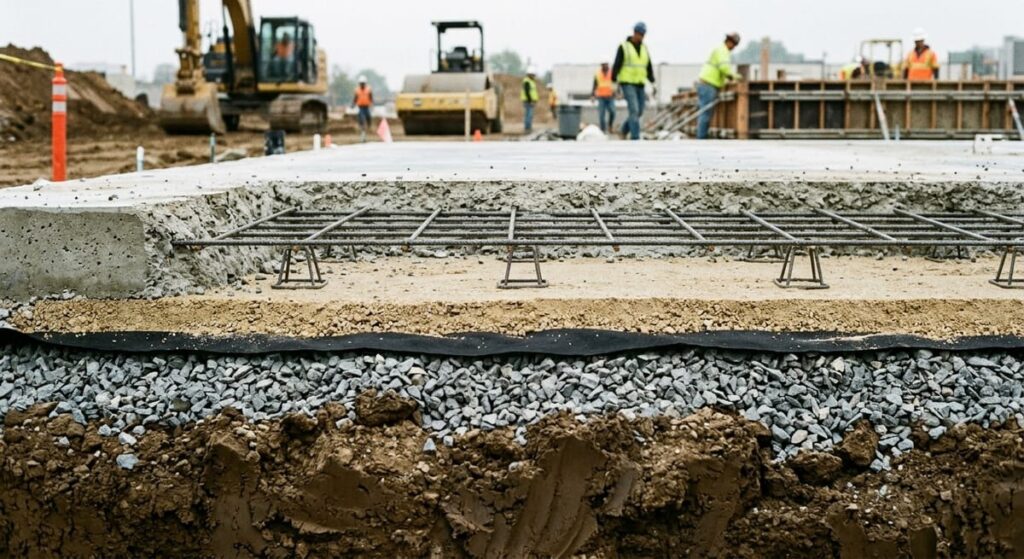
Industrial floor performance starts below the concrete. Remove all topsoil and organic material. Even small amounts compress under load, creating differential settlement. In north Georgia, this means excavating 12 to 18 inches below finished floor elevation.
Install geotextile fabric over exposed subgrade before placing base material. The fabric prevents clay soil from pumping up into the aggregate base under dynamic loading and moisture cycling.
Base material must meet specific gradation and compaction requirements. GDOT-approved Class II aggregate base provides the load-distributing layer between concrete and clay subgrade. Place and compact in maximum 6-inch lifts to achieve 95% Standard Proctor density. Nuclear density testing verifies compaction at representative locations: one test per 5,000 square feet minimum.
Vapor Barrier and Reinforcement Placement for Slab Systems
Place 10-mil polyethylene or 15-mil cross-laminated vapor retarder directly on the aggregate base. Overlap seams minimum 6 inches and seal with appropriate tape.
Position rebar at mid-depth using purpose-designed chairs rated for the bar size and concrete cover. For an 8-inch slab with #5 rebar, use 4-inch high chairs spaced to prevent bar sag.
Concrete Placement and Finishing for Industrial Thickness Requirements
Pour industrial slabs in planned sections matching joint layout. Pour size depends on concrete production capacity, crew size, and environmental conditions.
Place concrete as close to final position as practical. Use concrete with 4 to 5-inch slump for pumped placement, maximum 6-inch slump.
Strike off using laser-guided screed equipment to establish proper elevations and initial flatness. Modern laser screeds control elevation to within 1/8 inch across the entire floor area. Final finishing for heavy equipment floors emphasizes flatness and durability. Use laser-guided riding trowels to achieve specified FF/FL numbers.
Curing and Joint Cutting for Proper Slab Thickness
Spray-applied curing compounds meeting ASTM C309 provide practical moisture retention for industrial floors. Apply at 150 to 200 square feet per gallon immediately after final finishing.
Cut control joints within 6 to 12 hours after finishing, before random shrinkage cracks form. Joint depth should reach 1/3 to 1/4 of slab thickness. In an 8-inch slab, cut joints 2 to 2.5 inches deep.
Allow minimum 7 days (preferably 14 to 28 days) before exposing the slab to heavy equipment traffic. Early loading before concrete achieves design strength can cause surface damage and internal microcracking that reduces long-term performance.
Concrete Slab Thickness Specifications for Specific Equipment
Forklift Classifications and Thickness Requirements
| Forklift Class | Capacity Range | Minimum Slab Thickness | Typical Application |
| Class I & II Electric | 3,000-6,000 lbs | 6 inches | Standard warehouse, cushion/pneumatic tires |
| Class IV & V IC | 5,000-15,000 lbs | 8 inches | Sit-down IC units, pneumatic tires |
| Reach Trucks/Narrow-Aisle | Varies | 8 inches | Extended mast operations, high-bay storage |
| Heavy-Capacity | 15,000+ lbs | 10 inches | Large-capacity units, outdoor operations |
Forklift manufacturers provide specification sheets showing axle loads at maximum capacity and various lift heights. A 10,000-lb capacity reach truck might show front axle loading of 18,000 to 22,000 lbs when lifting maximum capacity to 25-foot height, significantly exceeding the forklift’s rated capacity.
Manufacturing Equipment Thickness Requirements
CNC Machines and Precision Equipment require 8 to 10-inch thickness not for load capacity but for vibration isolation and flatness maintenance.
Stamping Presses and Drop Hammers need 10 to 12-inch thickness with engineered vibration isolation systems. These machines create dynamic impact loads requiring specialized foundation design including mass concrete blocks isolated from the main floor slab.
Overhead Crane Systems require thickened concrete at column locations when crane support columns bear on floor slabs rather than independent footings. Thickness at column locations increases to 12 to 18 inches with thickened sections extending several feet from the column.
Vehicle Traffic Considerations and Slab Thickness
Federal bridge formula limits legal axle weights to 12,000 lbs single axle, 34,000 lbs tandem axle. But trucks operating on private property aren’t bound by these limits. Design must account for actual anticipated loads, not legal highway limits.
Semi-Truck Traffic requires 12+ inches minimum thickness at any location where tractor-trailers cross the slab, with engineered design based on actual axle loads and frequency.
Common Industrial Slab Problems and Prevention
Cracking from Insufficient Concrete Thickness
Random mid-panel cracking that doesn’t follow joint lines indicates the slab can’t handle imposed loads. Prevention requires honest load analysis during design, strict thickness verification during placement, and thorough subgrade preparation.
Joint Deterioration in Thin Concrete Slabs
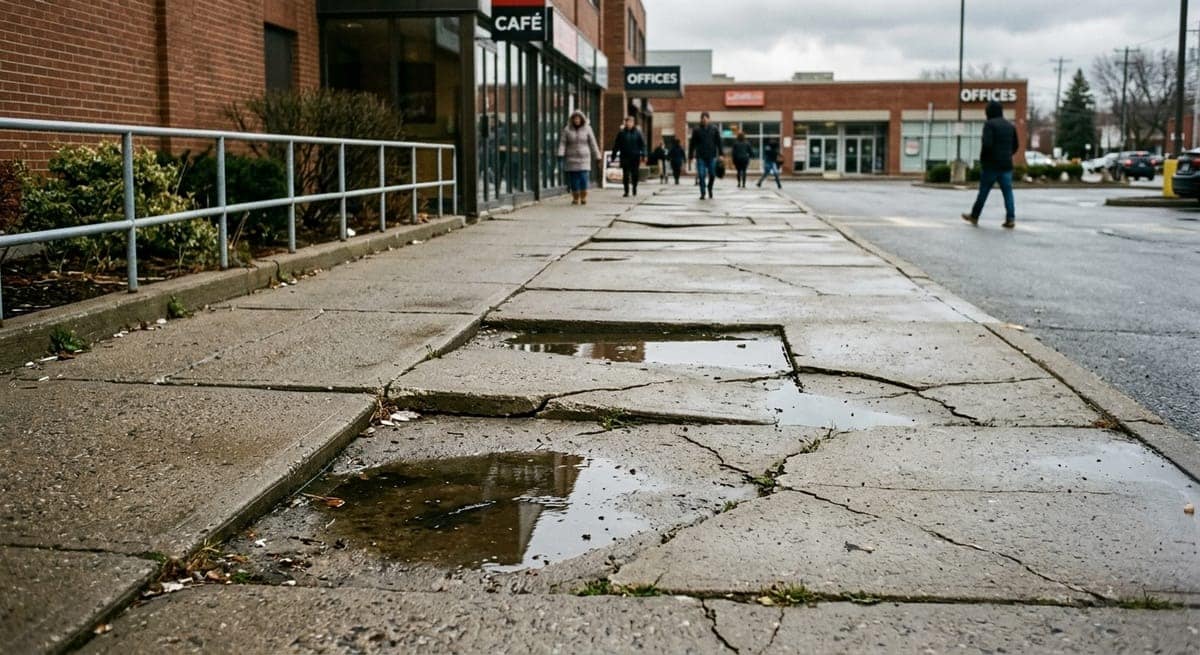
Joint edge deterioration progresses in predictable stages. Initial corner cracking occurs within 2 to 3 years when load transfer is inadequate. Spalling develops as repeated traffic impacts the unsupported corner. Eventually, the entire joint area requires full-depth replacement.
Semi-rigid polyurea joint sealants designed for forklift traffic provide superior performance compared to traditional silicone sealants. Resealing joints every 3 to 5 years maintains protection and extends slab life.
Surface Spalling and Settlement Issues
Lithium silicate densifiers penetrate concrete surface pores and react chemically to increase surface hardness by 40% to 60%, dramatically improving abrasion resistance. Application should occur 14 to 28 days after placement.
Differential settlement creates voids beneath slabs leading to cracking and structural failure. Prevention through proper initial construction costs a fraction of future repairs.
Cost Considerations for Concrete Slab Thickness Decisions
Moving from 6-inch to 8-inch thickness adds material cost (concrete volume increases 33%) plus modest increases in forming, reinforcement, and finishing labor. That investment prevents future expenses far exceeding initial savings.
Replacing a failed 6-inch industrial slab includes removal, disposal, downtime, and new construction. Choose adequate thickness the first time to avoid these multiplied costs.
Life-Cycle Value Analysis for Industrial Floors
Adequate Initial Specification (8-inch thickness, proper reinforcement):
- Expected service life: 35+ years
- Minimal maintenance requirements
- Continuous uninterrupted operations
Marginal Initial Specification (6-inch thickness, minimum reinforcement):
- Expected service life before major repair: 10-15 years
- Significant repair or replacement required
- Business disruption during repairs
- Operational restrictions while floor deteriorates
The “cheaper” option costs substantially more over typical ownership period.
For facilities across Cherokee, Cobb, and Fulton Counties where expansive clay soil creates additional complexity, professional design becomes critical. Standard thickness tables don’t account for regional soil behavior or specific operational demands.
Artistic Construction works with structural engineers on commercial concrete slab projects to translate engineering specifications into properly executed construction. We’ve poured commercial and industrial slabs throughout North Georgia for over 22 years, handling the full scope from subgrade preparation through final finishing on projects ranging from 5,000 to 50,000+ square feet.
If you’re planning a warehouse, manufacturing facility, or equipment storage building requiring concrete flooring designed for heavy equipment and forklift operations, contact our commercial concrete team for a project evaluation. We’ll assess your site conditions, review equipment specifications, and provide straightforward recommendations on thickness requirements, reinforcement, and construction methods matching your operational requirements.
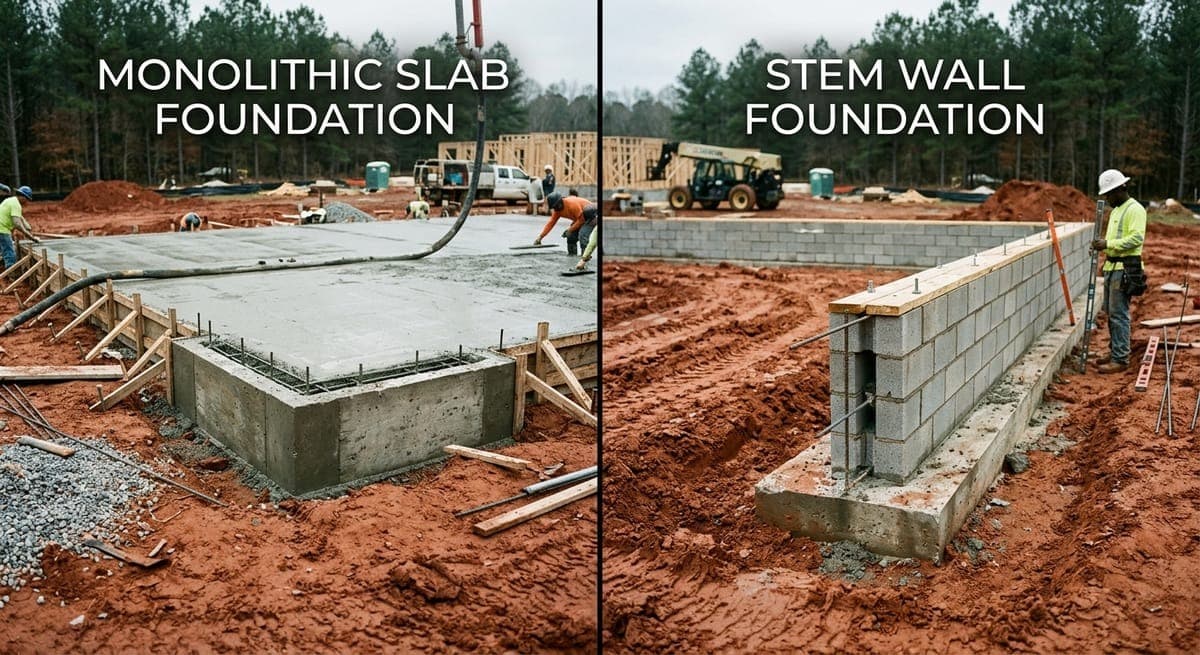
Heavy equipment floors aren’t the place to cut corners. The minimum thickness is exactly that: minimum. Real-world performance in Georgia’s soil conditions with the equipment you operate demands specifications at or above those minimums. For monolithic slab foundations or traditional approaches, get it right the first time.
Frequently Asked Questions About Concrete Slab Thickness
What is the minimum concrete slab thickness for garage floors with vehicle traffic?
Residential garage slabs require 4-inch minimum thickness for standard passenger vehicles. If you plan to store RVs, boats on trailers, or work trucks, specify 5 to 6 inches with proper reinforcement.
Can I use different concrete slab thickness throughout my facility if I have areas with different equipment?
Yes, industrial facilities require thickness variations based on actual loading zones. Design lighter-traffic areas at 6 inches while specifying 8 to 10 inches in forklift aisles and heavy equipment zones.
How do I verify my contractor is installing the specified concrete thickness during the pour?
Require depth verification at minimum 10 locations per 5,000 square feet using depth gauges or steel probes before concrete sets. Document measurements with photographs showing gauge readings and locations.
Should I specify fiber reinforcement in addition to rebar for my warehouse slab?
Yes, for industrial floors subjected to forklift traffic. Add synthetic macrofibers at 3 to 5 lbs per cubic yard to supplement structural rebar. The combined system significantly extends floor service life.
How soon can I allow forklift traffic on a new industrial concrete slab?
Wait minimum 7 days for standard concrete mixes, allowing concrete to achieve approximately 70% of design strength. Start with light equipment and limited traffic, gradually increasing to full operations over 14 days.