 Est. 2003
Commercial concrete slab cost guide for North Metro Atlanta businesses

When your business needs a commercial concrete slab installation in North Metro Atlanta, understanding the true cost per square foot goes beyond simple calculations. Commercial-grade concrete slabs have different thickness specifications, PSI requirements, and permitting processes than residential projects.
This guide breaks down commercial concrete slab costs in Woodstock, Canton, and Cherokee County, explains the reinforcement specifications your business type requires, and provides transparent cost factors so you can budget appropriately and evaluate contractor quotes with confidence.
What makes commercial concrete slabs different from residential
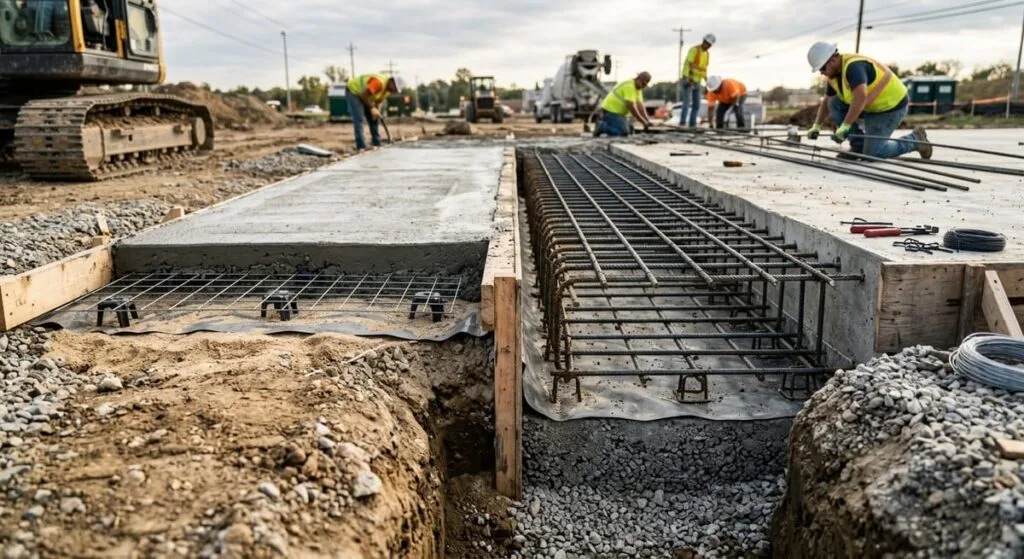
Commercial concrete slabs differ fundamentally from residential pours in structural specifications, load-bearing requirements, and regulatory compliance. A residential driveway uses 4-inch thick concrete with 3,000 PSI compressive strength and wire mesh reinforcement. Commercial concrete slabs require substantially heavier construction:
| Feature | Residential | Commercial |
|---|---|---|
| Slab thickness | 4 inches | 6–12 inches |
| PSI rating | 3,000 | 4,000–5,000+ |
| Reinforcement | Wire mesh | Engineered rebar grids |
| Engineering | Optional | Required with stamped plans |
| Inspections | Minimal | Multiple third-party inspections |
These enhanced specifications exist because commercial slabs must support heavier loads: warehouse racking systems, manufacturing equipment, constant forklift traffic, and heavy machinery vibration. Attempting to use residential specifications for commercial applications creates liability issues, code violations, and premature failure that costs far more to replace than building correctly from the start. If your project includes forklifts, presses, or storage for heavy equipment, our guide to minimum concrete slab thickness for heavy equipment breaks down the thickness ranges that match those loads.
Commercial concrete slab cost per square foot
Commercial concrete slab prices in North Metro Atlanta vary based on project type, thickness specifications, and site conditions.
Project type pricing breakdown
Light commercial (retail & office): serves foot traffic, display fixtures, and office furniture with minimal equipment loads. Standard specifications include ADA compliance and public occupancy ratings. Expect 4–6 inch thickness with 3,500–4,000 PSI concrete.
Medium commercial (warehouses): withstands forklift traffic, pallet jack operations, and concentrated loads from heavy racking systems. Precise joint placement prevents random cracking. These require 6–8 inch slabs with 4,000–4,500 PSI ratings.
Heavy industrial (manufacturing): requires slabs that support heavy machinery, resist chemical exposure, and maintain precision leveling under equipment vibration, demanding 8–12 inch thickness with 5,000+ PSI concrete and specialized finishing techniques.
Where your commercial concrete slab cost goes
| Cost category | Percentage | What it includes |
|---|---|---|
| Materials | 35–40% | Concrete mix, rebar, vapor barriers, joint materials |
| Labor | 30–35% | Forming, placement, finishing, curing |
| Site preparation | 15–20% | Grading, excavation, base material, compaction |
| Permits & engineering | 5–8% | Plans, engineer stamp, permits, inspections |
| Finishing | 8–12% | Surface prep, joint cutting, sealing, treatments |
For a precise quote on your commercial concrete project in Woodstock, Canton, or surrounding North Metro Atlanta, contact our commercial concrete contractors for a free site assessment with detailed line-item estimates.
Choosing the right commercial concrete slab specifications
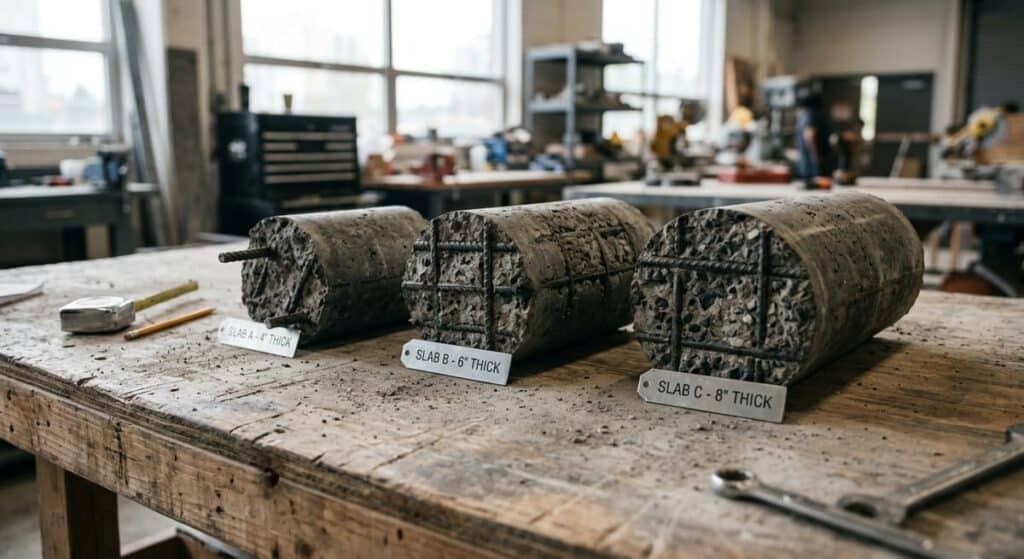
Selecting appropriate specifications prevents both over-engineering that wastes budget and under-specification that leads to premature failure.
Light commercial slabs (retail & office spaces)
- ✓ Thickness: 4–6 inches
- ✓ PSI rating: 3,500–4,000
- ✓ Reinforcement: wire mesh or #4 rebar at 18–24″ spacing
- ✓ Subgrade: 4–6 inches compacted aggregate base
- ✓ Control joints: maximum 10-foot spacing
- ✓ Compliance: ADA slope, slip-resistance (0.6 coefficient minimum), floor levelness within 1/8″ over 10 feet
Light commercial slabs focus on durability under moderate traffic rather than extreme load-bearing capacity. Proper subgrade preparation and joint placement prevent cracking that creates trip hazards and aesthetic concerns in customer-facing spaces.
Medium commercial warehouse slabs
- ✓ Thickness: 6–8 inches
- ✓ PSI rating: 4,000–4,500
- ✓ Reinforcement: #4 or #5 rebar at 12–18″ spacing both directions
- ✓ Subgrade: 6–8 inches compacted aggregate base with moisture barrier
- ✓ Flatness: FF25/FL20 minimum (FF35/FL25 for high-bay facilities)
- ✓ Control joints: coordinated with racking layout, 12–15 foot spacing
Floor flatness (FF) and floor levelness (FL) numbers become critical when forklifts operate at height in narrow aisles. Joint placement must align with racking layout, creating grid patterns that distribute loads across reinforced sections while avoiding control joints under racking posts where concentrated loads create failure points. For projects that need deeper support at columns, equipment pads, or perimeter walls, our commercial foundations and footings page explains the footing types we use across Metro Atlanta.
Heavy industrial concrete flooring
- ✓ Thickness: 8–12 inches
- ✓ PSI rating: 5,000–6,000+
- ✓ Reinforcement: #5 or #6 rebar at 8–12″ spacing, possibly post-tensioned
- ✓ Subgrade: 8–12 inches compacted crushed stone with engineered vapor barrier
- ✓ Flatness: FF35/FL25 or higher with laser-screed installation
- ✓ Surface treatment: chemical hardeners, lithium densifiers, or epoxy coatings
Industrial facilities handling oils, solvents, acids, or alkaline materials require surface treatments beyond standard concrete. Penetrating lithium silicate densifiers create a harder, less porous surface that resists chemical penetration. For severe chemical exposure environments, epoxy or urethane coatings provide an impermeable barrier. If your project also needs structural walls, our poured concrete walls page covers retaining, stem, and foundation walls for commercial sites across Metro Atlanta.
Commercial concrete permits and project timeline
Cherokee vs. Cobb County permit requirements
| Requirement | Cherokee County | Cobb County |
|---|---|---|
| Review timeline | 2–3 weeks | 2–4 weeks |
| Required docs | Stamped plans, site survey, soil report | Stamped plans, site docs, soil analysis |
| Inspections | Pre-pour, reinforcement, final | Pre-pour, reinforcement, final |
Both counties require multiple inspections. The pre-pour inspection verifies proper subgrade preparation, formwork installation, and vapor barrier placement. The reinforcement inspection occurs after rebar placement but before concrete delivery. Final inspection happens after curing completion and joint cutting. At Artistic Construction, we manage all permitting, engineering coordination, and inspection scheduling as part of our commercial concrete services with no additional project management fees. If your project also includes sidewalks, parking areas, ramps, or equipment pads, our commercial concrete flatwork page covers the other surfaces we build across Metro Atlanta.
Installation timeline by project size
| Project size | Permit review | Site prep | Installation | Curing | Total |
|---|---|---|---|---|---|
| 1,000–2,000 sq ft | 2–3 weeks | 2–3 days | 2–3 days | 28 days | 4–6 weeks |
| 2,000–5,000 sq ft | 2–4 weeks | 3–5 days | 3–6 days | 28 days | 5–8 weeks |
| 5,000–10,000 sq ft | 3–4 weeks | 1–2 weeks | 1 wk + 2–3 days | 28 days | 8–12 weeks |
Concrete achieves approximately 70% of design strength within seven days under proper curing conditions, allowing light foot traffic. However, full design strength requires 28 days of proper curing before heavy equipment, racking installation, and operational loads.
How Artistic Construction manages commercial concrete projects
We streamline commercial concrete slab installation by managing every phase under one contract: Pre-construction, site evaluation, engineer coordination, permit applications, timeline development. Preparation, subgrade work, base installation, forming, reinforcement placement. Installation, concrete placement, finishing to specification, proper curing protocols. Completion, final inspections, documentation, project closeout. For a closer look at that phase, see our commercial concrete slab curing timeline.
Licensed and insured in Cherokee and Cobb Counties, we’ve completed commercial concrete projects across North Metro Atlanta for over 22 years. Ready to start your commercial concrete project? Request your free estimate and site assessment today or call (678) 613-3424.
Frequently asked questions
How much does a commercial concrete slab cost per square foot in Georgia?
Prices in North Metro Atlanta vary based on specifications. Light commercial (retail, office) with 4–6″ thickness runs $6–8/sq ft. Medium commercial (warehouses) with 6–8″ slabs cost $8–12/sq ft. Heavy industrial facilities requiring 8–12″ thickness run $12–18/sq ft. These ranges include materials, labor, site preparation, permits, and finishing.
What’s the difference between commercial and residential concrete slab specifications?
Commercial slabs use thicker pours (6–12″ vs. 4″), higher PSI ratings (4,000–5,000+ vs. 3,000), and heavier reinforcement (rebar grids vs. wire mesh). They require engineered plans, commercial permits, and IBC code compliance. Residential-grade construction fails quickly under commercial loads.
Do I need a permit for commercial concrete in Cherokee or Cobb County?
Yes, all commercial concrete slabs require building permits in both counties. The review process takes 2–4 weeks. You’ll need engineered plans stamped by a Georgia-licensed engineer, site surveys, and soil reports. Artistic Construction handles all permitting, plan submissions, and inspection coordination.
How long does commercial concrete slab installation take?
Active installation takes 3–5 days for 1,000–2,000 sq ft projects, 5–10 days for 2,000–5,000 sq ft, and 2–3 weeks for 5,000–10,000 sq ft slabs. Add 2–4 weeks for permit approval before construction begins. Concrete requires 7 days minimum curing before light traffic and 28 days for full load capacity.
What PSI rating and thickness do I need for my commercial concrete slab?
PSI ratings depend on your business use. Retail stores and offices need 3,500–4,000 PSI with 4–6″ thickness. Warehouses with forklift traffic require 4,000–4,500 PSI and 6–8″ slabs. Manufacturing facilities with heavy machinery need 5,000+ PSI and 8–12″ thickness. An engineer evaluates your specific equipment loads and traffic patterns to specify the correct requirements.

Planning a project?
Skip the guesswork, get real numbers.
Reading is great. A clear, itemized estimate is better. Tell us what you have in mind.