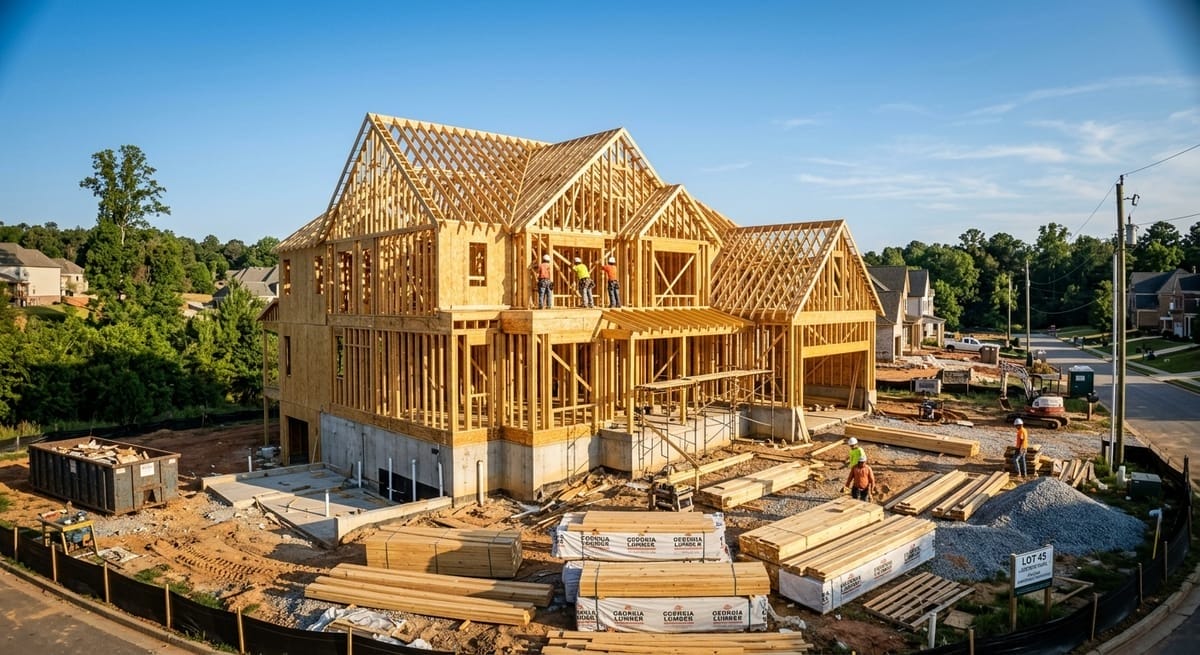
When you’re investing hundreds of thousands in a custom home in Metro Atlanta, your construction contract determines far more than payment methods. It shapes your entire building experience. The choice between fixed price and cost plus contract types affects budget certainty, design flexibility, cost transparency, and protection against construction cost overruns.
Most homeowners in Woodstock, Canton, and Alpharetta receive custom home builder agreement proposals using these structures but don’t understand the critical differences until they’re committed. This guide provides the honest construction contract comparison North Georgia builders rarely share.
What Are Fixed Price and Cost Plus Custom Home Building Contracts?
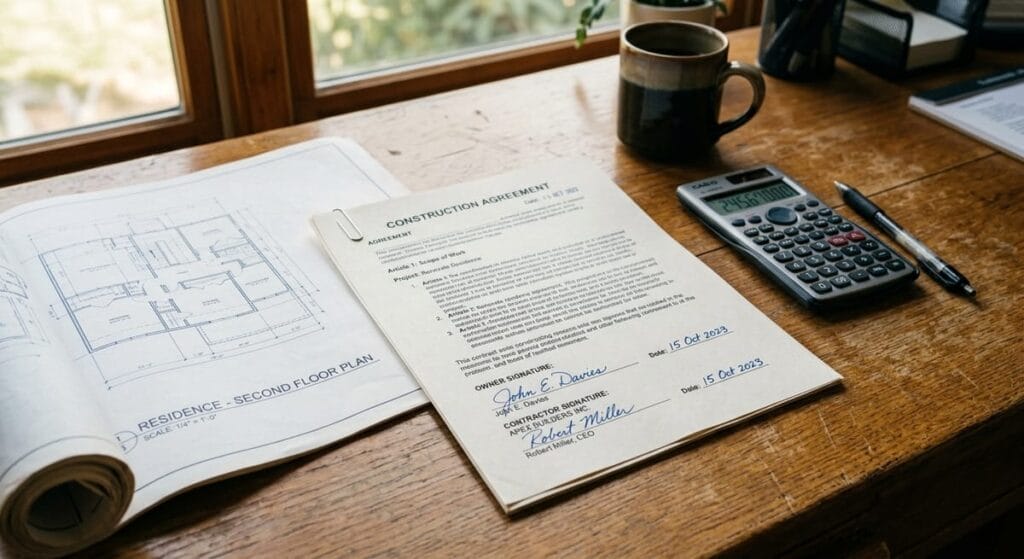
Fixed Price Contract Definition
A fixed price contract establishes one agreed-upon price for your entire project before construction begins. That number doesn’t change unless you request modifications. The builder absorbs cost overruns from material price increases, labor shortages, or unexpected site conditions.
Builders build in a premium above expected costs to cover this risk. You pay one price upfront, and the provider handles all variables.
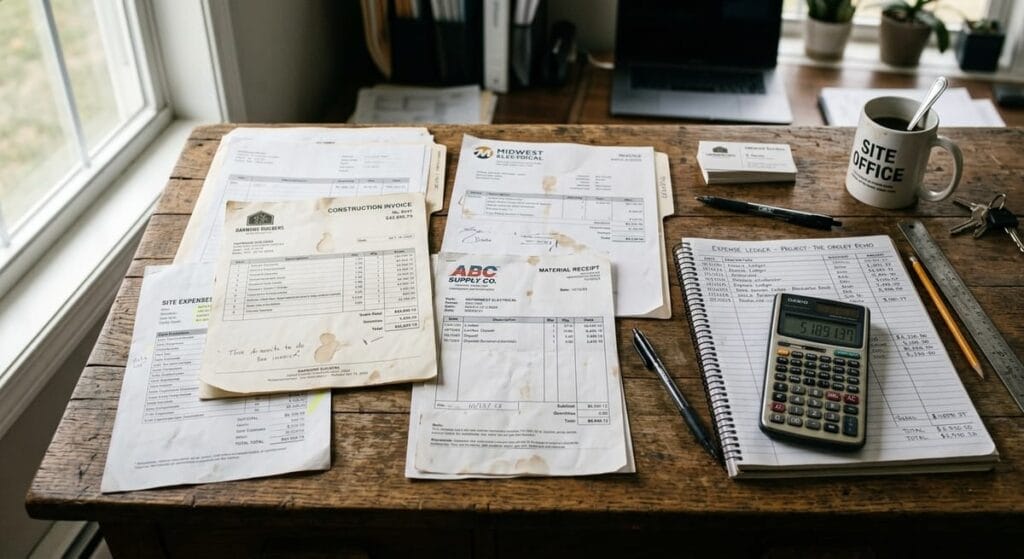
Cost Plus Contract Explained
A cost plus contract charges actual construction costs plus a builder’s fee. You pay for materials, labor, permits, and expenses at real cost, then add the builder’s markup. This cost plus fee structure provides complete construction contract transparency.
You see every invoice, receipt, and payment. The builder has no incentive to cut corners since they earn the same fee regardless of cost fluctuations. But you bear the risk if material prices spike or unexpected conditions require additional work.
The Core Difference Between Contract Types
The fundamental difference is risk distribution. Fixed price contracts place financial risk on the builder. Cost plus contracts place risk on you, the homeowner.
This creates opposite incentive structures. With fixed price building agreements, builders benefit from finishing quickly and minimizing costs, which can incentivize corner-cutting. With cost plus arrangements, builders benefit from quality work since their fee isn’t affected by efficiency.
Construction Contract Comparison Side by Side
| Factor | Fixed Price Contract | Cost Plus Contract |
| Budget Predictability | High, know total upfront | Lower, costs revealed during construction |
| Design Flexibility | Low, changes expensive | High, modifications at actual cost + fee |
| Cost Transparency | Medium, lump sum with detail | High, see every invoice |
| Your Financial Risk | Low, builder absorbs overruns | Higher, you pay actual costs |
| Builder’s Risk | High, must deliver within budget | Low, earns fee regardless |
| Timeline Pressure | Faster, builder incentivized | Longer, quality prioritized |
| Best For | Finalized designs, tight lending | Evolving designs, complex sites |
Understanding the Real Cost Difference
Fixed Price Contract: The builder quotes a single number that includes all costs plus their profit margin. When you want to upgrade finishes mid-project, change orders carry an additional markup beyond the normal margin.
Cost Plus Contract: You pay actual costs as they occur plus a consistent fee percentage. The same finish upgrade costs actual materials plus the agreed fee percentage, no penalty markup. But if unforeseen site conditions require extra work, you pay those actual costs plus the fee.
Fixed Price Contract Pros and Cons
Fixed Price Contract Advantages
Budget certainty for custom home budget planning: Lenders prefer fixed price contracts because they know exactly how much to approve. This matters in competitive Metro Atlanta neighborhoods where loan approval speed can determine whether you secure your preferred lot.
Builder motivated to finish on schedule: Builders earn profit only upon completion, creating strong incentive to manage subcontractors efficiently and maintain momentum.
Less homeowner involvement: Make decisions during design, then step back during construction. This appeals to professionals in Alpharetta or Roswell who travel frequently.
Easier to compare custom home builder agreements: When three builders submit proposals, directly compare bottom-line numbers. Cost plus estimates require evaluating fee structures, markup policies, and allowance assumptions.
Good for finalized designs: When plans are complete and you’ve specified every finish, fixed price works well.
Fixed Price Contract Risks and Disadvantages
Expensive change orders cause home building cost overruns: After signing, any modification triggers a change order with 30-40% builder profit markup in Metro Atlanta. Builders justify high markups by citing repricing time, schedule disruption, and subcontractor coordination.
Potential corner-cutting with lump sum contracts: If builders underprice to win business, they must cut costs somewhere to preserve profit. That means substituting lower-grade materials, rushing details, or pressuring subcontractors.
Allowance games: Builders set allowances artificially low. When you select actual materials, you exceed allowances and pay the difference plus markup.
Higher base cost: Most builders embed contingency to protect against unknowns. You pay this premium whether problems materialize or not.
When to Choose Fixed Price Contracts
- Design is 100% complete with all finishes specified
- Lot has been evaluated for subsurface conditions
- Building in established subdivisions with known soil conditions
- Lending requirements demand fixed pricing
- You’re uncomfortable with budget ambiguity
- First-time custom builder preferring defined costs
Cost Plus Contract Pros and Cons
Cost Plus Contract Advantages
Complete construction contract transparency: Receive copies of every invoice, material receipt, and subcontractor payment. Instead of wondering about builder profit markup, you see actual costs. This open-book accounting builds trust.
Design flexibility prevents change order penalties: When you decide mid-project to upgrade countertops or reconfigure the master closet, changes cost actual materials plus the same fee percentage, no penalty markup.
No quality-cutting incentive: Since the builder earns their fee as a percentage or flat amount, they don’t profit from cheap materials or rushed work.
Better for challenging custom home projects: North Georgia’s terrain includes steep lots in Canton, rock outcroppings in Ball Ground, and high water tables in some Alpharetta areas. Cost plus handles unforeseen conditions fairly.
You benefit from savings: If your builder finds efficient framers who complete work below estimate, you save that difference minus the fee percentage.
Cost Plus Contract Disadvantages
Less budget certainty: Your builder provides an estimate, but the final number isn’t guaranteed. If lumber prices spike or site conditions require additional foundation work, your investment increases.
Requires involvement: Review weekly cost reports, approve expenditures, and question charges that seem high. This takes time and attention.
Potential scope creep: Without a fixed ceiling, it’s easy to justify small upgrades that accumulate. Establish your maximum number at contract signing and enforce it.
Longer timelines: When speed doesn’t affect builder profit, projects sometimes stretch.
When Cost Plus Makes Sense for Custom Home Building
- Design is still evolving with anticipated changes
- Building on challenging lots with steep slopes or rocky subsurface
- Prioritizing quality and craftsmanship over schedule efficiency
- Comfortable reviewing costs with time for weekly oversight
- Experienced with construction or have an owner’s representative
- Want to select specific subcontractors for critical trades
Many clients choose Guaranteed Maximum Price (GMP) cost plus contracts. This hybrid combines transparency with budget protection: you get open-book accounting but establish a ceiling the total can’t exceed without approval. Understanding soft vs hard costs in custom home construction helps evaluate either contract type.
Custom Home Contract Safeguards You Must Have
Specific protections safeguard your investment and prevent problems that drain budgets and damage relationships.
Fixed Price Contract Protection Checklist
- Detailed scope requirements: Specify exactly what’s included down to recessed lights, bathroom fixture brands, and floor finish details. Require attachment of complete plans, specifications, and finish schedules.
- Itemized allowances with backup: Every allowance should show calculation basis. Instead of a lump sum for cabinetry, demand per-linear-foot calculations multiplied by total footage.
- Change order markup caps: Negotiate maximum markup percentages: 15-20% is reasonable, not 40%. Document this in your construction contract.
- Payment schedule tied to milestones: Never pay more than work completed. Standard schedules: 10% at signing, 25% at foundation, 25% at framing/roof, 25% at substantial completion, 15% at final walkthrough.
- Lien waiver requirements: Before each payment, require signed lien waivers from all subcontractors and suppliers.
- Builder’s risk insurance verification: Require proof that the builder carries builder’s risk insurance and liability coverage.
Cost Plus Contract Protection Checklist
- Open-book accounting access: Your contract must explicitly grant access to all backup documentation: actual invoices, receipts, and canceled checks, not just summary reports.
- Builder fee percentage cap: Clearly state whether the fee percentage applies to all costs or only direct construction costs. Some builders charge their fee on soft costs (permits, engineering). Negotiate to exclude these.
- Weekly cost reports: Require detailed weekly reports showing costs to date, current week spending, and projected remaining costs.
- Pre-approved subcontractor list: Require your builder to present three competitive bids for major trades (framing, roofing, electrical, plumbing, HVAC).
- Guaranteed maximum price option: Consider negotiating a GMP where the builder provides cost plus transparency but guarantees costs won’t exceed an agreed ceiling.
- Contingency fund management: Establish a 10-15% contingency fund for unforeseen conditions. Specify that you must approve any contingency spending over a certain threshold per incident.
Red Flags in Any Custom Home Builder Agreement
- Vague scope: Phrases like “builder’s discretion,” “standard quality,” or “similar materials” create ambiguity
- No itemized payment schedule: Large upfront deposits (over 10%) or vague milestone language create risk
- Unusually low bids: If one builder’s price is significantly below comparable estimates, they’ve missed something or plan to upcharge via changes
- Missing change order process: Professional contracts specify how changes are proposed, priced, and approved
- Pressure to sign quickly: “This price expires in 48 hours” tactics suggest the builder isn’t confident in their value
How to Choose Between Fixed Price and Cost Plus Contracts for Your Project
Decision Framework for Custom Home Building Contract Types
How finalized is your custom home design?
If plans are 95-100% complete with all finishes specified and unlikely to change, fixed price works well.
If design is 70-80% complete or you anticipate refinements as you see spaces framed, cost plus provides flexibility without expensive change order penalties.
What’s more important: budget certainty or design flexibility?
If financing at your maximum loan amount or budgeting tightly for furnishings, fixed price provides critical certainty.
If you have budget flexibility and value optimizing choices during construction (upgrading where it matters and economizing where it doesn’t), cost plus supports iterative refinement.
How involved do you want to be in construction contract oversight?
If your schedule limits availability for weekly cost reviews and frequent material selections, fixed price allows making most decisions upfront then stepping back.
If you’re engaged and want oversight into spending, cost plus rewards your involvement.
What’s your project’s complexity?
For straightforward lots in established subdivisions using standard construction methods, fixed price carries minimal risk.
For challenging lots with steep grades, rocky soil, or unique architectural features requiring custom solutions, cost plus handles the unknown more fairly. Cherokee County’s red clay and Ball Ground’s subsurface rock create conditions difficult to price without exploratory excavation.
How Artistic Construction Helps You Choose the Best Contract Type
At Artistic Construction, we’ve completed custom homes and major renovations across Metro Atlanta since 2002. We offer both fixed price and cost plus contracts because we understand different projects and homeowners suit different approaches.
During your consultation, we’ll review your specific situation: design status, budget parameters, schedule requirements, and site conditions. Rather than pushing one contract type, we’ll honestly assess which structure protects your investment while delivering the quality outcome you deserve.
Get Your Fixed Price Quote on Your Custom Home
Understanding the fixed price vs cost plus custom home contract decision matters more than most design decisions. It shapes your entire building experience and financial protection. Whether planning a custom home build in Woodstock, major renovation in Alpharetta, or addition in Canton, we’ll help you choose the contract aligning with your priorities.
Schedule your free consultation where we’ll review your project specifics and recommend whether fixed price, cost plus, or GMP best serves your needs.
Call (687) 613-3424 to discuss your project. Serving Woodstock, Canton, Alpharetta, Roswell, Kennesaw, Milton, Holly Springs, Ball Ground, Acworth, and Marietta.