 Est. 2003

Building a custom home represents one of your most significant financial commitments. If you’re planning a construction project in Woodstock, Alpharetta, or anywhere across Cherokee and Cobb counties, understanding construction draw schedules protects your investment throughout the building process.
A custom home draw schedule divides your total construction cost into 5-7 milestone-based payments. Instead of paying everything upfront, you pay progressively as work gets verified complete, protecting both you and your builder from financial risk.
This structure prevents contractors from disappearing with deposits or demanding payment for incomplete work, while ensuring your builder has cash flow to pay subcontractors and purchase materials on schedule. These construction milestone payments range from five draws for smaller projects to seven payment milestones for larger estates. If you are planning a custom home in Johns Creek, GA, our custom home builder in Johns Creek, GA page explains how the local review board and permit process shape the first draw.
What Is a Construction Draw Schedule and How Does It Work?
A construction draw schedule breaks your building contract into milestone-based payments rather than requiring full payment upfront. Each payment (called a “draw”) releases only when specific construction work reaches completion and passes third-party inspection.
How Builder Draw Schedules Protect Both Parties
Construction payment schedules eliminate paying for work that hasn’t happened. Each draw corresponds directly to verified progress, with independent inspections confirming completion before funds release.
Your builder receives predictable cash flow tied to actual construction progress. Instead of fronting massive costs while waiting months for payment, they receive funds as work advances, keeping quality subcontractors engaged and materials arriving on schedule.
The inspection requirement creates objective verification. Neither party relies solely on trust. An independent inspector confirms foundation work, framing, or finish carpentry meets contract specifications before the construction loan draw processes.
Custom Home vs Production Builder Payment Differences
Production builders working in subdivisions use standardized schedules with fewer, larger draws, sometimes just three payments covering 30% upfront, 40% at framing, and 30% at completion.
Custom home construction requires more granular payment milestones because every project is unique. Your builder can’t rely on standard timelines or predictable costs. A custom home in Milton with extensive stonework follows a completely different construction disbursement schedule than a contemporary design in Alpharetta with metal and glass.
Custom builders use 5-7 draws with no single payment exceeding 25% of the contract. This protects you from excessive financial exposure while giving your builder appropriate progress payments.
Typical Construction Draw Schedule Structure
Understanding when construction milestone payments occur and what they cover eliminates uncertainty about your building financing.
| Draw | Percentage | Milestone | Key Components |
| 1 | 10% | Pre-Construction | Permits, site prep, utility coordination |
| 2 | 15% | Foundation | Excavation, concrete, waterproofing |
| 3 | 20% | Framing | Structural framing, roof, weather protection |
| 4 | 20% | Mechanicals | HVAC, electrical, plumbing, insulation |
| 5 | 25% | Interior Finishes | Drywall, trim, flooring, cabinets, paint |
| 6 | 10% | Final Completion | Punch list, final inspections, CO |
Draw 1: Pre-Construction and Building Permits
This initial construction payment covers substantial administrative work before physical building begins. Your builder obtains building permits, coordinates utility connections, and completes final engineering reviews. Site preparation includes tree protection, temporary power installation, and establishing construction access routes.
Verification before draw payment: Issued building permits, executed subcontractor agreements, proof of builder’s liability insurance and workers’ compensation.
Draw 2: Foundation and Rough Grading
Foundation work covers excavation, footings, foundation walls, waterproofing, and initial backfill. For basement foundations common on sloped lots throughout Cherokee County, this construction phase includes full basement wall construction, underslab plumbing rough-in, and perimeter drainage systems.
Verification before draw request: Foundation inspection approval, concrete strength tests, waterproofing application, rough grading completion.
Draw 3: Framing and Dried-In Construction
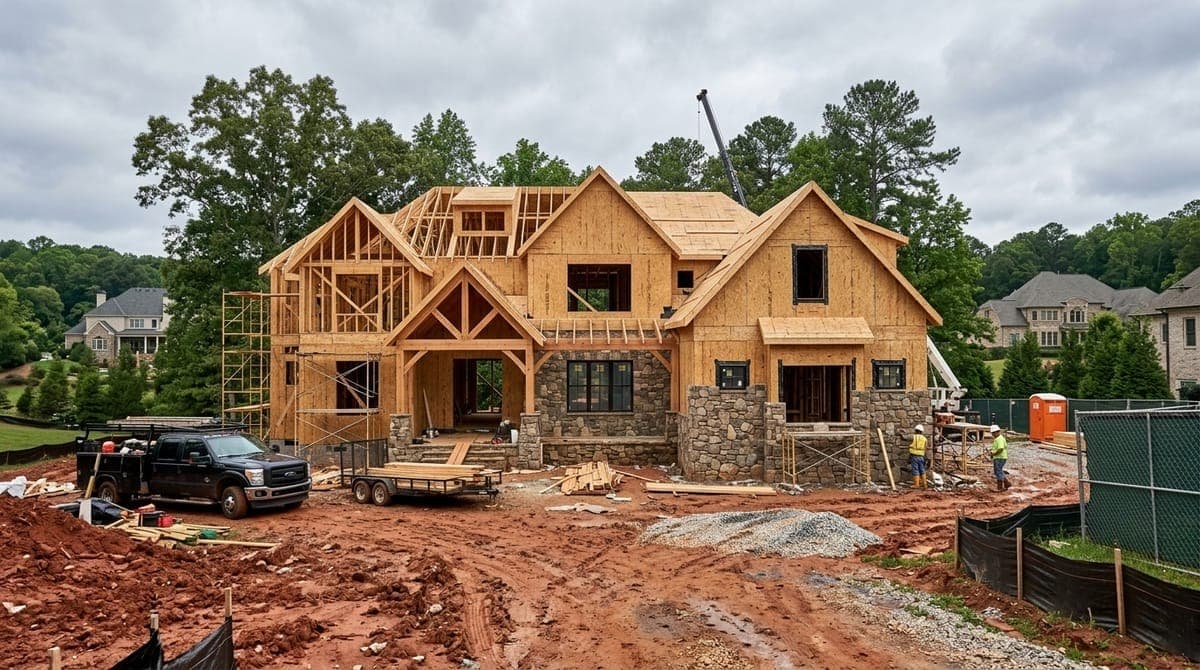
The most visible construction phase includes all structural framing: floor systems, wall framing, roof trusses or rafters, and sheathing. “Dried-in” means your home is weather-protected with roof covering, house wrap, and exterior windows and doors installed.
Verification before construction draw: Framing inspection approval, roof covering complete, windows and exterior doors installed with proper flashing, house wrap protecting wall sheathing.
Draw 4: Mechanicals and Insulation Installation
Major systems installation occurs during this construction phase. HVAC contractors install ductwork and equipment, electricians run wiring throughout the home, and plumbers complete supply and drain lines. Insulation goes into exterior walls and attic spaces.
Verification before draw disbursement: Rough mechanical, electrical, and plumbing inspections passed, insulation installed meeting code minimums, HVAC equipment set and connected.
Draw 5: Interior Finishes and Custom Details
The largest single construction payment covers finish work defining your home’s character. Drywall installation and finishing, interior trim and millwork, flooring, kitchen cabinets and countertops, bathroom vanities, interior doors, and paint all occur during this extended phase.
Verification before draw payment: Drywall finished and painted, flooring substantially complete, kitchen cabinets installed, bathroom vanities set, interior doors hung and operational.
Draw 6: Final Completion and Construction Retainage
The final construction payment releases only after complete project completion, final inspections, and Certificate of Occupancy issuance. This draw includes punch list completion, final cleaning, appliance installation, and remaining exterior work.
The 10% retainage withheld until this stage ensures your builder completes every detail before receiving final payment, providing financial incentive to address your punch list items promptly.
Verification before final draw: Certificate of Occupancy issued, final inspections passed, punch list substantially complete, lien waivers from all subcontractors and suppliers received.
Your Construction Budget Blueprint Through Schedule of Values
Every construction draw schedule connects to a Schedule of Values (SOV), the itemized budget showing exactly how your total contract price breaks down. Your SOV lists every work category with its dollar value: site work, foundation, framing, and so forth through every trade. If you are planning a build in Forsyth County, a custom home builder in Cumming, GA can walk you through how site work, septic, and foundation costs show up in the SOV.
Before signing your construction contract, review the SOV line by line. Compare percentages to industry standards. Understanding soft vs hard costs helps you evaluate whether your SOV includes all necessary components.
The SOV becomes your reference throughout construction. When your builder submits a construction draw request, you’ll see exactly which line items contribute to that payment.
How Construction Draw Inspections Protect Homeowners
Professional builder draw schedules include multiple safeguards minimizing financial risk throughout your construction project.
Third-Party Construction Draw Inspections Before Every Payment
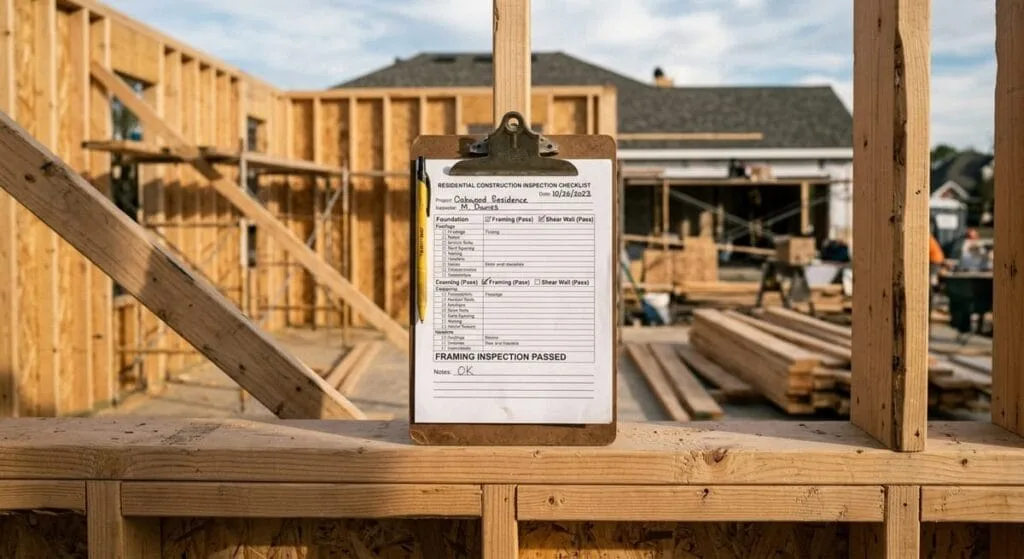
Before your builder submits any draw request, an independent inspector must verify work completion. This isn’t your builder’s employee. It’s your construction lender’s inspector or a municipal building official.
For construction loan draw projects, your lender requires inspections before releasing each disbursement. The lender-hired inspector visits your job site, verifies the work matches the draw request, and confirms completion meets contract requirements.
If you’re building with cash, hire an independent inspector to verify completion before each construction payment.
Lien Waivers Prove Subcontractors Were Paid
A mechanics lien allows unpaid subcontractors or suppliers to place a legal claim against your property. If your builder receives your construction payment but doesn’t pay the framing crew, that crew can file a lien against your home even though you already paid your builder. That risk is one more reason to work with a custom home builder in Sandy Springs, GA who files permits, tracks payments, and collects lien waivers before each draw.
Lien waivers prevent this scenario. Before your builder receives each draw, they must provide signed lien waivers from every subcontractor and supplier paid from the previous construction payment.
Review lien waivers your builder provides. They should cover all subcontractors and material suppliers who worked during the previous phase. Missing lien waivers indicate potential payment problems that could affect your property.
Your Right to Withhold Construction Payments When Work Isn’t Complete
Georgia construction law protects homeowners who withhold payment for legitimate deficiencies. If your contract specifies work that remains incomplete or fails to meet standards, you have legal grounds to withhold corresponding payment.
This right requires following proper procedures. Document deficiencies with photos and written descriptions. Notify your builder in writing, specifically identifying incomplete or deficient work. Provide reasonable opportunity for correction before withholding payment.
The withheld amount should correspond proportionally to the incomplete work.

Red Flags in Builder Payment Schedules to Watch For
Certain payment structures indicate potential problems:
Large upfront deposits exceeding 10% suggest cash flow problems or front-loaded contracts. Legitimate custom builders don’t need excessive deposits before starting construction work.
Builders who resist third-party draw inspections eliminate your objective verification. If a builder says “trust me, you don’t need an inspector,” that’s precisely when you need one most.
Refusal to provide lien waivers indicates payment problems with subcontractors. Professional builders provide complete lien waiver packages with every construction draw request.
Payment requests that outpace visible progress represent classic overpayment risk. If payments exceed completion percentages, you’re dangerously overexposed.
Construction Loan Draw Process and Payment Schedules
Most custom home buyers use construction financing rather than cash, which adds another layer to the builder draw schedule. Understanding how construction loans coordinate with builder payment schedules prevents confusion and delays.
Construction-to-Permanent Loans Explained
A construction-to-permanent loan (single-close loan) provides financing for both the construction phase and your permanent mortgage in one transaction. You close once, paying one set of closing costs, and the loan automatically converts from construction financing to a traditional mortgage when building completes. If you are building in Marietta, our custom home builder in Marietta, GA page explains how city versus county permits affect the first draw.
During construction, you make interest-only payments on funds disbursed to your builder through the construction loan draw process. Once construction completes and the loan converts, you begin normal principal and interest payments.
This loan structure dominates custom home construction financing because it’s simpler and more cost-effective than a construction-only loan requiring separate permanent financing after completion.
Construction Loan Draw Request Timeline From Submission to Disbursement
The process from your builder submitting a draw request to receiving construction payment takes 3-7 business days.
Day 1: Your builder submits a construction loan draw request to your lender, including detailed descriptions of completed work, invoices from subcontractors and suppliers, lien waivers from the previous draw, and photos documenting progress.
Day 2-3: Your lender reviews the draw request and orders a construction draw inspection.
Day 3-5: The inspector visits your job site, verifies work completion, and confirms the dollar amount requested aligns with actual progress.
Day 4-6: The lender receives and reviews the construction draw inspection report. If the report confirms appropriate completion, the lender approves disbursement.
Day 5-7: The lender disburses funds via wire transfer to your builder’s account or through title company escrow.
This timeline assumes everything proceeds smoothly. Delays occur when draw packages are incomplete, construction draw inspections reveal deficiencies, or documentation is missing.
What Your Construction Lender Requires Before Releasing Draw Payments
Construction lenders have strict disbursement requirements protecting their financial interest:
| Requirement | Purpose |
| Construction draw inspection verification | Confirm work completion justifies requested amount |
| Lien waiver packages | Prove builder paid for earlier work |
| Building permit compliance | Verify current permits with all required inspections passed |
| Budget alignment | Ensure each draw aligns with approved construction budget |
How to Create a Construction Draw Schedule
If you’re reviewing a builder’s proposed draw schedule or negotiating payment terms, these practices protect your interests.
6 Questions to Ask Your Builder About Their Payment Schedule
- How many draws does your standard construction draw schedule include, and what triggers each payment? Six to seven draws is standard for custom homes.
- Who performs construction draw inspections before you request each payment? The answer should specify third-party verification: lender-hired inspectors, municipal inspectors, or independent third parties you engage.
- What lien waiver process do you follow? Professional builders provide comprehensive lien waiver packages with every construction draw request.
- How do you handle situations where construction work isn’t complete when a draw milestone occurs? Look for answers acknowledging that delays happen and describing fair adjustment mechanisms.
- What percentage of the contract represents your largest single draw payment? No single draw should exceed 25-30% of the total contract.
- Can you provide a sample Schedule of Values and builder draw schedule template for a project similar to mine? Reviewing actual SOV documents from comparable projects helps you understand how they itemize costs and structure construction milestone payments.
How to Review Your Schedule of Values Line by Line
Your Schedule of Values deserves careful analysis before signing your construction contract.
- Verify percentages align with typical construction draw schedule norms: Foundation represents 12-18% of total costs for custom homes without basements, 18-25% with basements. Framing runs 15-20%.
- Confirm all construction work is itemized: Generic line items like “construction” or “labor” indicate poor cost tracking. Professional SOVs break down costs specifically.
- Check that contingency is included: Responsible builders include 5-10% contingency for unforeseen conditions.
- Look for allowances and confirm amounts: Allowances cover items you’ll select later: lighting fixtures, plumbing fixtures, flooring, tile.
- Total the line items: Simple math verification ensures the SOV components sum to your contract price.
Documentation You Should Track at Each Construction Draw
Maintaining organized records protects you if disputes arise and provides valuable information for insurance, taxes, or future sales.
Create a construction draw folder containing:
- Your signed construction contract and all amendments
- The Schedule of Values
- Copies of all draw requests your builder submits
- Construction draw inspection reports from every payment
- Lien waiver packages for each draw
- Photos documenting progress at each milestone
- Copies of all building permits and inspection approvals
Negotiating Builder Draw Schedule Terms
Some construction payment schedule elements are negotiable while others represent industry standards protecting both parties.
Flexible elements: Number of draws (5-7 is typical, but you might negotiate 8-9 for larger projects), specific percentage for each construction milestone payment, retainage percentage held until final completion (5-10% is standard range), payment timing after inspection approval.
Fixed elements that protect you: Requirement for third-party construction draw inspections before payments, lien waiver collection before draw requests, limiting any single draw to 25-30% maximum, prohibiting upfront deposits exceeding 10%, requiring Certificate of Occupancy before final payment.
Building your custom home represents a significant financial commitment, but a properly structured construction draw schedule protects your investment throughout the building process. By understanding how milestone payments align with verified progress, requiring third-party construction draw inspections, and collecting lien waivers at each stage, you ensure that your money releases only as work is completed to contract standards. If you’re comparing builders in north metro Atlanta, a custom home builder in Dunwoody, GA should also handle permits, inspections, and lien waivers at each draw.
At Artistic Construction, we’ve structured builder draw schedules for custom homes across Metro Atlanta for over 22 years, maintaining transparent communication and verified milestone completion throughout every project.
Ready to start planning your custom home with complete financial transparency? Contact us for a free consultation to review construction draw schedules and financing options specific to your project.
Frequently Asked Questions About Construction Draw Schedules
How many draws are typical for a custom home construction project?
Most custom homes use 5-7 draws depending on project size and complexity. Smaller projects use 5 construction milestone payments, while larger homes use 6-7 draws for better cash flow management and more granular progress tracking.
What percentage should each construction draw be in a typical draw schedule?
Industry standard percentages are: Pre-construction and permits (10%), Foundation (15%), Framing and dried-in (20%), Mechanicals and insulation (20%), Interior finishes (25%), Final completion and retainage (10%). Exact percentages vary based on your project’s specific scope.
Can I negotiate my construction draw schedule with my builder?
You can negotiate the number of draws, specific percentages within reasonable ranges, and retainage amounts (5-10%). Non-negotiable elements should include construction draw inspection requirements before payments, lien waiver collection, and third-party verification processes that protect you.
What’s retainage and why is it held until the end of the construction draw schedule?
Retainage is 5-10% of the contract price withheld until final project completion and Certificate of Occupancy. It ensures your builder completes all punch list items, addresses any deficiencies, and fulfills all contract obligations before receiving the final construction payment.
Do I need a construction loan or can I pay cash using a builder draw schedule?
Both approaches work with construction draw schedules. Construction loans coordinate builder draws through mandatory lender inspections and disbursement processes. Cash building offers more flexibility but requires disciplined payment verification through independent inspectors before releasing each payment.
What happens if my builder requests a construction draw but work isn’t complete?
You have the legal right to withhold payment proportional to incomplete work. Document deficiencies with photos, notify your builder in writing, and provide reasonable opportunity for correction. Your construction contract should include dispute resolution mechanisms if you and your builder disagree about completion status.
How long does the construction loan draw process take from request to disbursement?
The construction loan draw request timeline is 3-7 business days from draw request to fund disbursement. This includes lender review (1-2 days), construction draw inspection scheduling and completion (2-3 days), and final approval and payment processing (1-2 days). Experienced builders who submit complete draw packages minimize delays.


Planning a project?
Skip the guesswork, get real numbers.
Reading is great. A clear, itemized estimate is better. Tell us what you have in mind.